In February, students in this class became consumer scientists as they tested to learn if certain product claims actually held up. Students worked in teams to set up tests that followed an experimental design. They experienced different forms of scientific experimentation first hand and from beginning to end with each different product test.
Bubbles! Yes, we decided to test two different bubble solutions to see which one made the biggest bubble! SuperMiracle brand seemed a good choice given its name. It was pitted against our own homemade bubble solution. Actually measuring the bubble size was almost as fun as blowing them. Students blew a bubble on a solution-wet table top until it popped and measured the remaining soap ring. All other variables were held as constant as possible. After 100 bubbles were measured, and all data analyzed our results showed that -- Wow! Our homemade solution made consistently bigger bubbles, and it cost way less than SuperMiracle solution!
The next consumer test was was even more exciting -- to compare bubble gum. From soap bubbles to bubble gum! The question was, "What happens to the mass of gum after chewing it for 10 minutes?" Do you know? You could ask the class because after devising a fun experiment of weighing, chewing and weighing again, they determined that it decreases dramatically. So did the sweet taste and the pleasure of chewing! After inspecting the package labels of the different brands and flavors, they learned that the #1 ingredient in bubble gum is sugar. So guess where all of that mass went. In all cases, the mass decreased over 60%. Some lost a whopping 75%!
Paper towel testing was the last experiment. Do you know which brand of towel is the strongest and most absorbent? This class now has a good idea. Again working in groups, each chose a quality of towel to test and devised their own experiment to do so. Absorbency or strength were chosen. They tested 4 brands of towel. Bounty was a winner in both categories, but our school brand towel was the strongest!
Lots of learning, lots of fun, and some many more experiments the class wants to do!
Sunday, February 20, 2011

Crystals, Rocks and Minerals Unit
No outdoor rock hounding during this snowy January 2011! We did, however, spend cozy afternoons inside having fun learning about what this planet Earth is all about. The class started deep within looking at the amazing things going on, and the changes that produce big events  on the surface, such as volcanoes, mountains, and earthquakes.

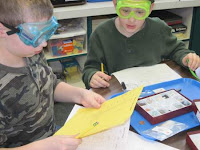
Using the school's beautiful crystal and rock collection, students learned about the difference between minerals and rocks and about different kinds of each. Some of the most fun came with using the mineral and rock test kits.


The rock cycle was explored and added to their list of abiotic cycles that occur on earth.
Everyone also learned how to "grow" their own crystals!


 on the surface, such as volcanoes, mountains, and earthquakes.
Using the school's beautiful crystal and rock collection, students learned about the difference between minerals and rocks and about different kinds of each. Some of the most fun came with using the mineral and rock test kits.


The rock cycle was explored and added to their list of abiotic cycles that occur on earth.
Everyone also learned how to "grow" their own crystals!


Thursday, December 23, 2010
Digging Up the Past -- Archaeology
With this introduc tion to the tools, techniques and wonder of archaeology, students spent all of December learning about the way of life of people in Maine starting about 20,000 years ago. They learned about the three main archaeological periods -- Paleo, Archaic, and Ceramic Periods and about the major geologic and climate changes.
A huge highlight was to have Mr. Dave Backman as a guest teacher for four sessions. Dave brought with him his expertise and experience with this subject to the classroom, along with many, many artifacts for the children to observe, handle and try to figure out what they were and what they were used for.
Here students are finding artifacts in a mock dig, with authentic artifacts found in Freeport, that he devised. Would you know from looking that these are ancient stone tools?


Have you ever seen woolly mammoth teeth? The black one is fossilized!

Students then made their own pinch pots using a technique that our ancient ancestors used.
They also built an outdoor brick kiln to fire them in!

The pots were placed carefully in layers of sawdust by Mrs. Christie, art teacher.
She and I lit the fire and quickly capped it so that the fire would smolder many hours until the pots were done.


Here's what they looked like after the firing...

And here they are all cleaned up and ready to take home.
 tion to the tools, techniques and wonder of archaeology, students spent all of December learning about the way of life of people in Maine starting about 20,000 years ago. They learned about the three main archaeological periods -- Paleo, Archaic, and Ceramic Periods and about the major geologic and climate changes.
A huge highlight was to have Mr. Dave Backman as a guest teacher for four sessions. Dave brought with him his expertise and experience with this subject to the classroom, along with many, many artifacts for the children to observe, handle and try to figure out what they were and what they were used for.
Here students are finding artifacts in a mock dig, with authentic artifacts found in Freeport, that he devised.
 Would you know from looking that these are ancient stone tools?


Have you ever seen woolly mammoth teeth? The black one is fossilized!

Students then made their own pinch pots using a technique that our ancient ancestors used.
They also built an outdoor brick kiln to fire them in!

The pots were placed carefully in layers of sawdust by Mrs. Christie, art teacher.
She and I lit the fire and quickly capped it so that the fire would smolder many hours until the pots were done.


Here's what they looked like after the firing...

And here they are all cleaned up and ready to take home.

Wednesday, December 22, 2010
Ecosystems -- Nature's Communities
Rain forests, deserts, grasslands, tundra, coniferous and deciduous forests were the topics of study during the month of November. Students learned what makes each biome different and about the many cycles within the biomes. They also built terreria of the biomes and ate foods from each area. A really great website for children that is all about the major biomes is:
http://mbgnet.net/index.html
Rain forests, deserts, grasslands, tundra, coniferous and deciduous forests were the topics of study during the month of November. Students learned what makes each biome different and about the many cycles within the biomes. They also built terreria of the biomes and ate foods from each area. A really great website for children that is all about the major biomes is:
http://mbgnet.net/index.html
Friday, November 5, 2010
Magnetism and Electricity -- Nature's Forces

During the month of October, the students who participated in the Magnetism and Electricity Unit had much to look forward to each day. Starting with the basic concepts of magnetism, students learned about the force field around a magnet, its forces of attraction and repulsion, and how to test its strength. They then made and experimented with electromagnets.
Once everyone was able to find a way to get their light bulb to light using a bulb, a battery and one wire, they then went on to make other simple circuits. They also learned how to do some basic trouble shooting when their circuits failed to work.
From there, the class was given the challenge to design and make their own working flashlight with an on/off switch. Everyone made a drawing of their design showing the circuit pathways first.
Then they gathered their materials and got to work. After three class sessions, everyone had a working flashlight!


Another exciting part of the unit was do some basic trouble shooting when their circuits failed to work.
From there, the class was given the challenge to design and make their own working flashlight with an on/off switch. Everyone made a drawing of their design showing the circuit pathways first.
Then they gathered their materials and got to work. After three class sessions, everyone had a working flashlight!


learning about safety around electricity. Mr. Bradley Kaherl from CMP visited the school to give a presentation to the entire Soule program about the dangers of electricity and ways to stay safe.

Saturday, September 25, 2010
Ferry Beach Ecology Unit September 2010
Wow! This is an amazing unit for students and teachers alike. During the month of September all of the Mast Landing fourth graders are learning about the ABC's of ecology. From weather and climate to food webs and cycles in nature, students are being introduced to the many biotic and abiotic factors that are involved in our environment.
In-class lessons and outdoor explorations at school are combined with a special one-day program by Ferry Beach Ecology School staff at Mast Landing. The FBES staff used funny skits and songs to engage students in understanding various science concepts. They also took the children out into our school woods to investigate the forest ecosystem.

Then we all headed to Ferry Beach Ecology School in Saco for three days/two nights of being immersed in ecology lessons. We all stayed in Rowland Hall, a large dormitory. Many parent chaperones and 4 teachers and about 90 students! The children got settled into their rooms, then did a practice fire drill. Here is the dorm and one of the FBES staff getting the children ready for their first activity.
All of the lessons complemented the concepts and topics that were taught in school. Each morning we went for a walk on the beach followed by a weather data collection. Here the FBES naturalist is in crazy costume as we learn about weather conditions and record them.
One of the hallmarks of the FBES experience is staff performing skits to introduce students to important ecology concepts and vocabulary. They really ham it up with costumes and humor and songs.
 At every breakfast meal in the cafeteria, the weather squad then reports in dramatic fashion what the weather will be for the day to the entire population of FBES. Here MLS students are with the naturalists giving the day's report.
Students are assigned to 8 different study groups. These are the groups that they are with the three days. Each group has at least one MLS adult and one FBES naturalist.
Here are some group s at the Biddeford tide pools exploring intertidal organisms.


During the evening sessions, the children had one indoor and one outdoor activity. The first night they learned all about the organisms and the ecosystem of the tide pools in preparation for the next day's explorations. This was done with a skit followed by rotating group activities.
The second night they went on a "Nature at Night" walk to learn about what is needed for nocturnal animals to get by. They participated in activities using their senses minus sight. Some groups even got to hear a great horned owl hooting and an answering female! Each night students also wrote in their MLS journal or in the booklet given by FBES.
The last day was spent packing up and then going on an Abiotic Adventure. The children learned about the various aboitic factors of nature and how they dramatically affect the living, biotic world.


It was an awesome, educational, and unforgettable experience for everyone involved. Ferry Beach Ecology School is a wonderful place. If you want to learn more about Ferry Beach just go to
www.fbes.org or ask a 4th grader!
In-class lessons and outdoor explorations at school are combined with a special one-day program by Ferry Beach Ecology School staff at Mast Landing. The FBES staff used funny skits and songs to engage students in understanding various science concepts. They also took the children out into our school woods to investigate the forest ecosystem.

Then we all headed to Ferry Beach Ecology School in Saco for three days/two nights of being immersed in ecology lessons. We all stayed in Rowland Hall, a large dormitory. Many parent chaperones and 4 teachers and about 90 students! The children got settled into their rooms, then did a practice fire drill. Here is the dorm and one of the FBES staff getting the children ready for their first activity.
All of the lessons complemented the concepts and topics that
 were taught in school. Each morning we went for a walk on the beach followed by a weather data collection. Here the FBES naturalist is in crazy costume as we learn about weather conditions and record them.
One of the hallmarks of the FBES experience is staff performing skits to introduce students to important ecology concepts and vocabulary. They really ham it up with costumes and humor and songs.
 At every breakfast meal in the cafeteria, the weather squad then reports in dramatic fashion what the weather will be for the day to the entire population of FBES. Here MLS students are with the naturalists giving the day's report.
Students are assigned to 8 different study groups. These are the groups that they are with the three days. Each group has at least one MLS adult and one FBES naturalist.
Here are some group
 s at the Biddeford tide pools exploring intertidal organisms.

During the evening sessions, the children had one indoor and one outdoor activity. The first night they learned all about the organisms and the ecosystem of the tide pools in preparation for the next day's explorations. This was done with a skit followed by rotating group activities.
The second night they went on a "Nature at Night" walk to learn about what is needed for nocturnal animals to get by. They participated in activities using their senses minus sight. Some groups even got to hear a great horned owl hooting and an answering female! Each night students also wrote in their MLS journal or in the booklet given by FBES.
The last day was spent packing up and then going on an Abiotic Adventure. The children learned about the various aboitic factors of nature and how they dramatically affect the living, biotic world.


It was an awesome, educational, and unforgettable experience for everyone involved. Ferry Beach Ecology School is a wonderful place. If you want to learn more about Ferry Beach just go to
www.fbes.org or ask a 4th grader!
September 2010 Start of a new school year
Hello! As you may know, I teach in the afternoons at Mast Landing School and share a room with Ms. Guernsey who is there in the morning. This year, I teach Language Arts to our shared homeroom and I teach afternoon units. All of my afternoon units are science units, and we have started the year off with a fabulous unit that includes an extended field trip to Ferry Beach Ecology School for all of the fourth graders in the school! This blog primarily will be about the science units.
Subscribe to:
Posts (Atom)

