Monday, December 26, 2011

Design and Build Unit January 3 - February 16, 2012

Wow! What a fun unit!

Everybody worked with a partner and learned about designing and building, from creating basic blueprint plans, to making materials lists, and writing step-by-step instructions to guide their work. After learning this design process, students then built their constructions.


First, working groups used real woodworking tools and basswood to make catapults. Which was more fun -- making the catapults or doing the test runs flinging wet sponges to find the greatest average distance the sponge would go?


Once certain benchmarks were met creating the catapults, students then dove into designing and building their own working vehicles. Partners needed to decide on the basic plan, and on what kind of power their car would use to travel three meters. Through careful planning and constant trouble-shooting, students learned many aspects of design technology and moved at their own pace.


There were wind-powered cars, rubber band power, push power, propellers, and motor powered cars.

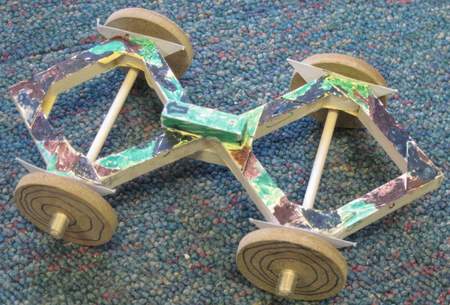
We had a great time. Wish you were there!


Sunday, December 11, 2011

Me and My Family November 28 - December 22, 2011


How does one get mom's curly hair and dad's brown eyes? Can everyone in one's family fold their tongue?

This unit introduced students to basic ideas of genetics, such as traits, DNA, types of cells, chromosomes, mutations, and how traits are passed on to them from their parents. Students surveyed the class for common traits, made a time line, developed a family tree, and learned about Gregor Mendel.

Here are some of the timelines and family trees created by the students. Also, our school secretary, Fran Townsend, whose avocation is genealogy, was a guest visitor to our class. She shared her many stories of her family history and her extensive family tree.


Friday, October 21, 2011

Mystery Matter! October 31 - November 22, 2011

Lab coats and safety goggles were needed for this science unit about matter and its physical and chemical properties. Students were given five unidentified mystery substances, and by learning and using the scientific process of experimentation, they were able to observe many of the properties and behaviors. With each different experiment, students saw how the substances behaved and carefully kept records of what they discovered.

After many sessions, the class narrowed down the possibilities for each substance and made their hypotheses about the identities. Finally, the unknown substances were revealed. The final test of what was learned (content and process) then came when each child was given a secret mixture of at least two of the substances. On their own, each had to perform whatever experiment he or she thought appropriate to identify the ingredients.

Tha Art and Science of Birds October 3 - 29, 2011

Our art teacher, Mrs. Christie, and I collaborated to teach this unit about the scientific wonder and artistic beauty of birds. Students learned about the adaptations, habitats, and behaviors of many different birds.


They were introduced to the prehistoric pteradon (a flying mammal) and to archaeopteryx (a reptile-bird transition species). By researching certain facts about a modern bird, each student was able to write a brief report on one bird of their choice. They also painted beautiful watercolor renditions of their birds and created beautiful bird journals. When the class went outside to do some birdwatching and to practice using their binoculars, they spotted a downy woodpecker, chickadees, crows, and a vulture.


At the end of the unit, everyone was able to take home their own handmade ceramic bird bath/feeder to hang up. Many thanks to Maine Audubon Society in Falmouth for the loan of several mounted birds for the classroom.


Here are a few of the bird posters that now hang near the front office as you enter the school,


These are some of the beautiful bird journals that students created with Mrs. Christie.

The Science of Toys September 7 - 29, 2011


Using everyday toys and toys that they created themselves, students in this first unit of the year got to play with toys and learn important science principles of motion, force, energy, and pressure. Toys such as the Flip-a-Frog, the Ball-and-Cup, cardboard airplanes, and Cartesian divers were assembled and observed closely to understand what forces in nature make them behave the way they do.


A toy that the children built called the Whimmy Diddle, a wooden stick with notches filed into it with a propeller on one end that gets rubbed firmly with another stick, was a striking example of friction and its uses. Newton's three laws of motion were discussed and observed directly with each new toy the class investigated.


Based on what they learned from these experiences with toys on earth, students then predicted how they thought the toys would behave in outer space! All predictions were then checked when the class viewed a video taken by NASA astronauts within the space station. Do you know how a spinning top would behave in space? Do magnetic balls act the same in space as on Earth? What about a bouncing ball? Ask the students from this class!

Wednesday, August 31, 2011

Welcome to the 2011-2012 school year!

This year the first PM unit in science that I will offer the children is called The Science of Toys. It should be fun-filled and full of science concepts. Stay tuned for more.

Saturday, April 16, 2011

Classroom Pets -- Pros and Cons

Mast Landing School held its Health Fair in April, and this unit was done with that in mind. It was all about staying healthy around pets, keeping pets healthy, and why certain pets are fine for a classroom setting and others are not.
Through research, discussion, and classroom visitors (human and non-human), the class learned about the desirable qualities of pets and about the needs of different pets. Their research covered our responsibilities toward our pets too. Students read the MLS pet policy of no fur, no feather and researched the health reasons for this policy.
Microscopes were brought out to take a close look at dander from different pets, bacteria, feather dust, and some other common allergens. A nurse from Mid-coast hospital visited to have the children learn about hand washing and germs.
Students' posters of their research and some pets were then on display at the Health Fair.