Saturday, December 29, 2012

Design and Build January 2 - February 7, 2013

Design and Build  January 2 - February 7, 2013


Back by popular demand, students once again participated in this challenging and fun engineering science unit.  By drawing blueprints with different views and using metric scale and measurement, students designed and built several structures. 

They used hand tools and basswood to first learn how to make strong, square corners and angled joints to build a model catapult.


With their models, they then chose a variable to test to see how far the catapult would fling an object.  Using the engineering and technology aspect of the STEM model of science learning, students observed in their models the effect of differing weights being flung with no change in force.  Much discussion about mass, force, momentum, gravity and acceleration ensued around the use of the catapults. 


After this, students used all that they learned to design and construct their own moving vehicle, which also was tested and refined. 
 Each group of two students designed and built a unique vehicle that moved without human power.  
Some cars used wind power, some used motors, some used rubber band/propeller power, others used gravity down a ramp.  Everyone's vehicle passed the challenge -- to travel a distance of three meters.


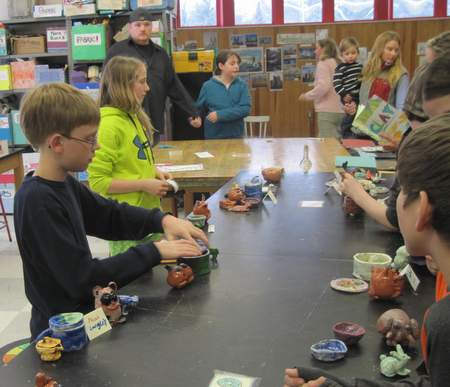
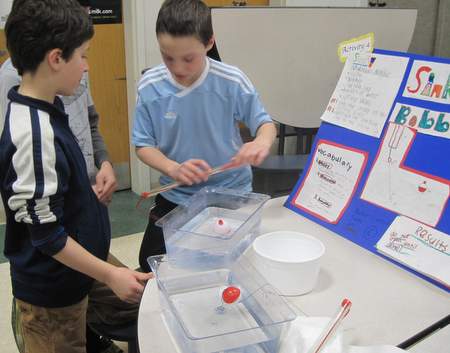
Celebrating Science Afternoon was an exhibit in the Soule Program that concluded this month of work in this class and in all of the other Soule Program classes, even the art class!  


Students shared what was learned in each class during the past month and prepared activities to highlight their learning and to allow parents and students to participate.  Besides the Design and Build class, other science displayed at the fair included a class about Sound, a class about Sink and Float, and a class about the physical and chemical properties of clay and glazes.






Sunday, December 9, 2012

Optics: The Study of Light  December 4 - 20, 2012


Have you ever been in a completely dark room?  Students attempted to block out all light from their classroom. 


Refraction!
During this short unit, students learned about the beauty and fascinating behavior of light.
To begin, students learned about what light is, how it travels, and how we see.  Then the class set up several light boxes to explore and experiment with using white light and colored light.


    Groups around light boxes were challenged to use their mirrors, protractors, rulers, etc. to send one light beam completely around the four sides of the light box.

Prisms, mirrors, shadow probe sticks, protractors, and rulers were more tools that they used to help students understand how light beams bend, spread out and blend together.


Another challenge:  making white light from colored light!


Have you ever created a multicolored shadow? We did!

Thursday, October 25, 2012


Magnetism and Electricity  October 29 - November 30, 2012


Using magnets, wires, bulbs and batteries, and the science process, students investigated the basic principles of magnetism and electricity.


Everyone participated in an experiment to determine the strength of magnetic force when additional magnets were added onto a stack of magnets.


Students also learned about electromagnetism, and experimented with the effect that the number of wire coils around a nail would have on its magnetic strength.


They then learned about circuits and  how a battery and bulb work.


Finally, they were challenged to create their own working flashlight using their knowledge of electrical energy and circuitry.
After much discussion, planning, designing, trouble shooting, and redesigning, students were able to create their own circuitry, including on/off switches and build unique working flashlights.


Central Maine Power's Mr. Brad Kaherl also joined us for a presentation to the entire Soule Program on electrical safety.


Tuesday, October 9, 2012

Secret Formulas  October 1 - 25, 2012
Mixing, measuring, comparing, and understanding physical and chemical changes were the main activities in this unit.  Students  learned to use the tools and process of science as they figured out possible proportions of ingredients for making substances such as paste and a cola-type drink.  They learned to write simple formulas and made their own secret formula for each substance.


First, the children learned to use many measuring tools of science.  They used triple beam balances to weigh things, graduated cylinders to find liquid volume, metric rulers for length, and thermometers for temperatures.

Working in groups, students then explored the properties of some ingredients that paste and cola drinks are made of.  From there, groups were able to determine which ingredients worked best to make a great all-purpose paste and a tasty cola drink.  Everything required careful measuring and observing, as well as good recording of results.  Getting the proportions just right required fine tuning.


Everyone then shared their secret formulas with the class and explained why they chose their specific formulas. They even created fun advertisements for their cola drinks. 

Sunday, September 2, 2012

Experimenting With Bubbles  September 4 - 27, 2012

This year, the Soule teachers tried something new during our PM unit time.  For this first unit, all students rotated through classes with the four Soule teachers.  The classes were one week sessions.  In this way, all Soule students experienced, right off the bat, each teacher and their subject and style of teaching. Other first units included art, social studies, and health/fitness.


Experimenting With Bubbles  This unit was the first unit of the year and it was meant to introduce students to a fun way to engage in the experimentation process.

 Students used a simple bubble recipe to create and test different brands of soaps and their effect on bubble size.  They learned about how to conduct a fair test and about the importance of identifying and using a test variable.  The classes also learned how to use the metric system to measure accurately the size of a bubble.
Good clean fun, don't you think?

Sunday, April 29, 2012

Healthy Foods From Healthy Soils  April 23 - May 22, 2012

All Soule and Harraseeket third graders are now participating in this unit.  It involves myself, Mr. McKibben and Ms. Pearson too.  We are focusing on what specific environmental and biological components are necessary to provide healthy food and water for all.  

A major aspect of this unit is our collaboration with Wolfe's Neck Farm where we will be spending an entire week.  There, we will work with the animals, help plant, learn about composting, and about nutrition, and many other topics.  Also, in conjunction with the Freeport Historical Society, students will be creating 15+ scarecrows to be donated to the farm, to the Historical Society's Pettingill Farm and to Mast Landing School.  When we return to school in September, some scarecrows will still be at work in our school gardens protecting our plants.

Friday, April 13, 2012

Kitchen Chemistry March 19 - April 12, 2012


Our kitchen cabinet and the many common items found in it constituted the framework for this unit's focus on how matter behaves. Using everyday household substances, students learned about the properties of matter, physical changes, chemical changes, atoms, molecules, and reactions.

Is turning cream, sugar and vanilla into yummy ice cream a physical or chemical change? The students discussed this matter while munching on their own homemade ice cream. How about making pancakes? In our own "Chemical Change Cafe", students pondered the evidence for which kind of change occurs to make pancakes while the pancakes were cooking on the griddle. What about the maple syrup? Did the sliced strawberries that went on top undergo a chemical or physical change? These were among the hot topics that the class explored.

Chocolate chip cookies provided the centerpiece for a discussion on conservation of matter, while a whole host of substances found in the kitchen were used to understand the what acids and bases are.

This unit was a fun and tasty introduction to the amazing world of chemistry.